
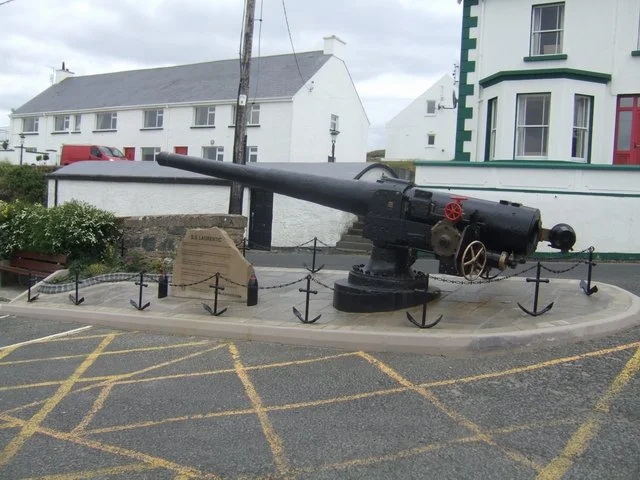
SS Laurentic Gun
The gun on the pier in Downings
The “Laurentic Gun” beside Downings Pier is a rare, full‑scale piece of First World War naval hardware: a seven‑metre gun weighing more than seven tons, recovered from the wreck of the liner-turned-armed merchant cruiser Laurentic and mounted as a public landmark.
A locally placed stone beside the gun identifies it as a 6‑inch gun and records that it was recovered in September 2007 by divers from the area, with the consent of the wreck’s owners. It also explicitly frames the artifact as a memorial to the 354 lives lost in the disaster (and, more broadly, to lives lost at sea during warfare).
What the gun was doing on Laurentic
Although best remembered today as a transatlantic passenger liner, Laurentic was taken into wartime service and employed as an armed merchant cruiser—one of dozens of converted merchant vessels used by the Royal Navy for patrol and escort duties.
In that role, the ship’s listed armament included eight 6‑inch guns and two 6‑pounder guns, a layout that matches the common “one of eight” phrasing often attached to the Downings display—meaning one of the eight 6‑inch deck guns originally carried, rather than “one of eight that were recovered.”
Recovery and installation from seabed to shoreline
The gun now at Downings was not raised during the early 20th‑century treasure salvage that made the wreck famous. Instead, it was lifted in modern times by a locally based diving effort associated with Sheephaven SAC , with particular credit repeatedly given to Kevin McShane for raising, restoring, and displaying the ship’s gun at the pier.
Contemporary reporting describes a multi‑year preparation and recovery. Divers spent roughly three years on preparatory dives before the gun could be freed and lifted; the work involved loosening the massive piece from the wreck (described as being on the bow deck) and attaching heavy lifting chains to a flotation system designed for the job.
By April 2010, the gun had been on the pier for about two and a half years and was formally presented as a tourist attraction, with public funding contributing to the cost of mounting and interpreting it.
The disaster that left the gun underwater
In late January 1917, Laurentic was on passage toward Canada from Liverpool (often described specifically as bound for Halifax ) and made an unscheduled stop at Buncrana in Lough Swilly before returning to sea.
After leaving the mouth of Lough Swilly—described in local Donegal interpretive material as “between Dunree Head and Fanad Head ”—the ship struck two mines in quick succession and went down in rough winter conditions.
Multiple modern summaries converge on the core human toll: 475 people were aboard; 354 died; only survived, with many deaths occurring after evacuation because men succumbed to exposure in bitter cold while awaiting rescue.
The mines that sank Laurentic are widely attributed to the German minelaying submarine U‑80, and Laurentic appears in U‑80’s World War One “ships hit” record dated 25 January 1917.
Why the gun became iconic: gold, diving, and remembrance
The wreck’s enduring “magnetism” is inseparable from the bullion cargo carried on that final voyage. A primary, near‑contemporary account of the recovery operations records that 3,211 gold bars went down with the ship and that salvage work ultimately brought up 3,186 bars—“more than 99 per cent” of the gold—implying 25 bars remained unaccounted for when the main recovery concluded.
That same account also documents how hazardous and technically demanding the salvage became as the crushed wreck shifted and silted over, forcing methods that ranged from blasting access routes to prolonged excavation and “shipbreaking” to expose the seabed beneath plating.
Later public retellings vary on the precise number of bars still missing (some cite low‑twenties figures; some claim that only about 20 remain), but the consistent point is that not all the bullion was recovered—fueling a long‑running local legend and helping to keep the site in the imagination of divers and visitors.
The Downings gun matters in this context because it connects the “gold ship” story back to what the wreck also is: a place of loss. The memorial text at the pier explicitly dedicates the artifact to the men who died that night, anchoring remembrance in an object that was physically present on the ship during her final minutes.
Burial and commemoration details are themselves part of the “living history” around Laurentic in Inishowen. Accounts differ on exact numbers interred at individual sites: one local Donegal source states that the largest number of bodies lie in a mass grave at St Mura’s in Fahan , while the Laurentic memorial project notes that the memorial inscription refers to 68 at St Mura’s, that newspapers reported 69, and that the burial record book was later amended to 73; it also records two burials in Cockhill cemetery in Buncrana.